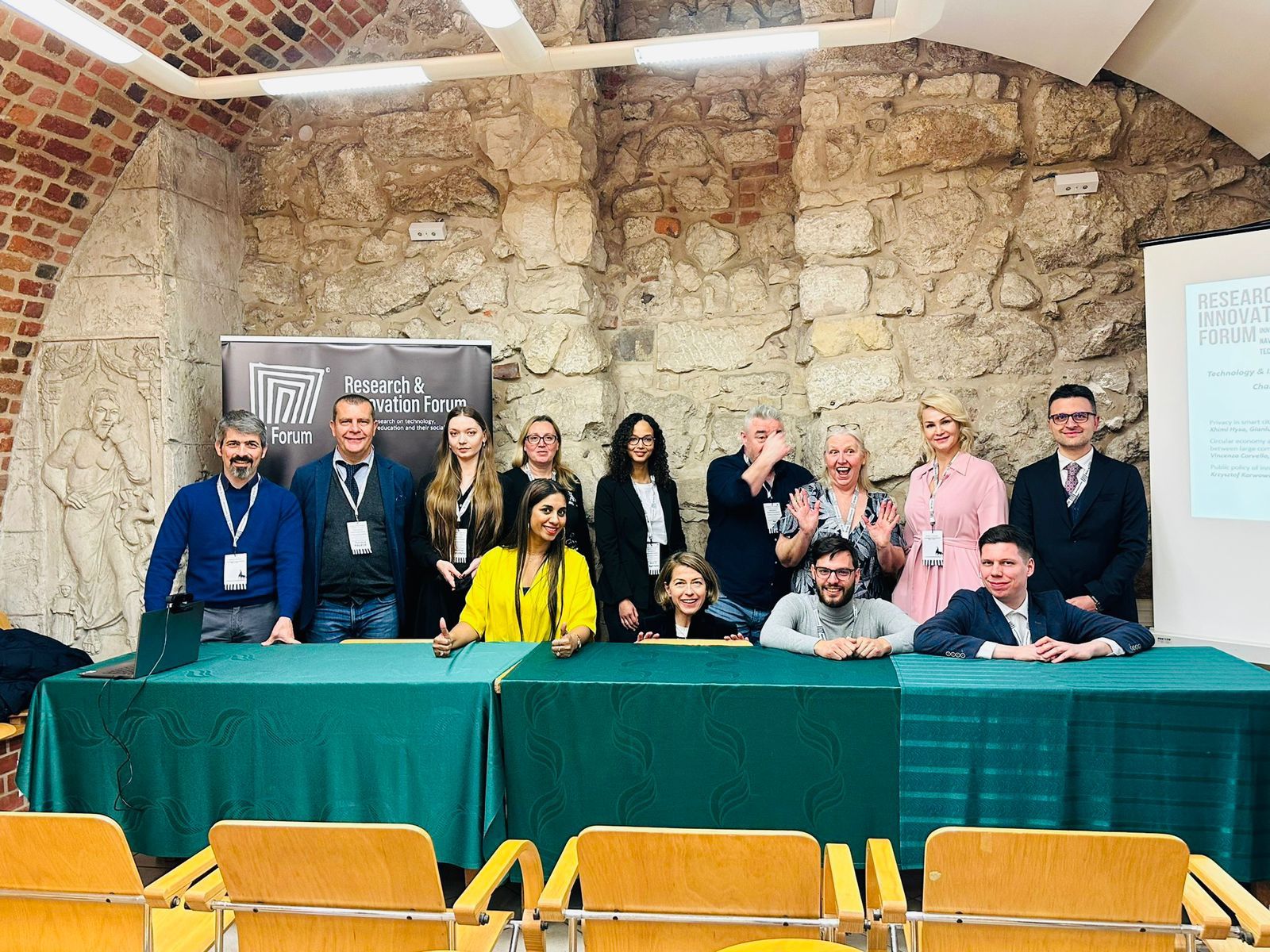
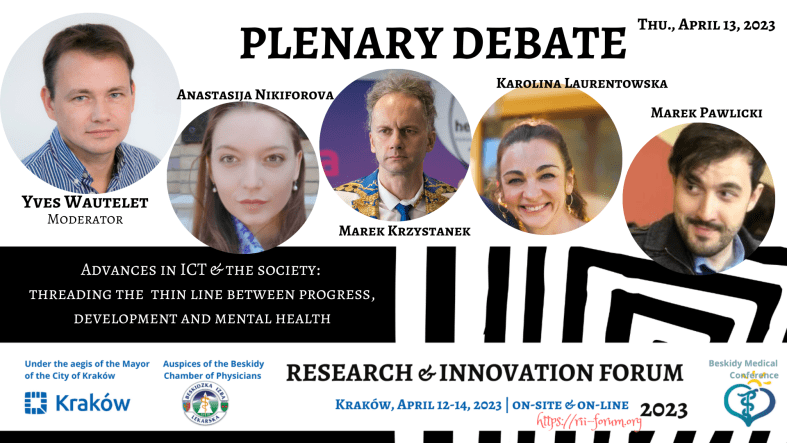
Last week, I had an unforgettable experience at the Research and Innovation Forum (RiiForum) on which I posted previously in Krakow, Poland, serving as plenary speaker and session chair. It was another great experience to have an absolutely amazing plenary session titled “Advances in ICT & the Society: threading the thin line between progress, development and mental health”, where we – Prof. Dr. Yves Wautelet, Prof. Dr. Marek Krzystanek, Karolina Laurentowska & Prof. Marek Pawlicki – discussed disruptive technologies in our professional lives in the past years, how they affected us and our colleagues, how they affect(ed) society and its specific groups, including their mental health, and general perception of technology, i.e. an enemy of humanity, or rather a friend and support, and how to make sure the second take place. And from this we have developed a discussion around AI, chatGPT, Metaverse, blockchain, even slightly touching on quantum computing. Of course, all this was placed in the context of democracy and freedoms / liberties. All in all, we approached the topic of governance and policy-making, which is too often reactive rather than proactive, which, in turn, leads to many negative consequences, as well as elaborated on the engineering practices.
To sum up – emerging and disruptive technologies, Blockchain, AI, Metaverse, digital competencies, education, liberty, democracy, openness, engagement, metaverse, inclusivity, Industry 5.0, Society 5.0 – and it is not a list of buzzwords, but a list of topics we have managed to cover both plenary speakers and the audience and continued to talk about them during the whole conference. Rich enough, isn’t it?
And then the day did not end, continuing with several super insightful sessions, where, of course, one I enjoyed most is the one that I chaired. Three qualitative talks with further rich discussion after each thanks to an excellent audience, despite the fact this was the last session of the day (before the dinner), namely:
Privacy in smart cities using VOSviewer: a bibliometric analysis by Xhimi Hysa, Gianluca Maria Guazzo, Vilma Cekani, Pierangelo Rosati
Public policy of innovation in China by Krzysztof Karwowski, Anna Visvizi
How Human-Centric solutions and Artificial Intelligence meet smart cities in Industry 5.0 by Tamai Ramirez, Sandra Amador, Antonio Macia-Lillo, Higinio Mora
And the last, but not the least, Krakow surprised me lot (in a positive sense, of course) – it was my first time in Poland, and I am absolutely glad that it was on such a beautiful city as Krakow – the place with the rich history and culture! Thank you dear RiiForum2023 organizers – Anna Visvizi, Vincenzo Corvello, ORLANDO TROISI, Mara Grimaldi, Giovanni Baldi and everyone who was involved – it is always a pleasure to be a part of this community!
On behalf of the organizers (Technical Program Chair, Steering Committee, and finally publicity chair) of the IEEE International Conference on Intelligent Computing, Communication, Networking and Services (ICCNS2023), I am inviting everyone, who is conducting research in this area, to consider submitting the paper to it.
Call for Papers:
New advancements in wireless communication systems such as Fifth-Generation (5G), Beyond Fifth-Generation (B5G), and Sixth-Generation (6G) networks will allow for new and unprecedented services to be made available for users with nearly unlimited capacity. These services will be the core driver for future digital transformation of our cities and communities. This will be accompanied by a ubiquitous deployment of Internet of Things (IoT) infrastructure and supported by computing capacity that will be available at the edge of the network and in the cloud. This computing infrastructure will handle the processing of data generated by users and services. Such a complex and diverse system will require the applications running on the computing/networking infrastructure to be Intelligent, efficient and sustainable. Additionally, the infrastructure will require smart control and automation systems to integrate and manage its different components. Artificial Intelligence (AI) and its applications will play a significant role in the design, deployment, automation, and management of future services. This will include applications that will be running on the edge and on cloud servers, networking applications to handle the flow of data between the users and the computing system, and intelligent automation and management software operating on the system. The International Conference on Intelligent Computing, Networking, and Services is aiming to provide an opportunity to present state of the art research in the intersections of Computing, Networking, and Services that are supported by Artificial Intelligence.
Researchers from both the industry and academia are encouraged to submit their original research contributions in all major areas, which include, but are not limited to the following main tracks:
💡Track 1: Artificial Intelligence Fundamentals
Artificial Intelligent Systems
Artificial Intelligent Theory
Artificial Intelligent applications in Computers and Communications
Artificial Intelligent and Robotics Technologies
Artificial Intelligent and cloud computing
Artificial Intelligent for Economic paradigms and game theory
Machine and Deep Learning of Knowledge
Artificial Intelligent based Distributed Knowledge and Processing
Artificial Intelligent for Human-Robot Interactions
💡Track 2: Intelligent Internet of Things and Cyber-Physical Systems
Intelligent IoT Applications and Services
Intelligent security for the Internet of Things and cyber-physical systems
Intelligent Internet of Things architectures and protocols
Intelligent Cyber Physical Systems (CPS)
Blockchain-based application in Intelligent Manufacturing: Industrial Internet of Things,
Blockchain and Secure Critical Infrastructure with Industry 4.0
Intelligent manufacture and management
Consensus and mining algorithms suited for resource-limited IoTs
Blockchain-based Controlled mobility and QoS
Blockchain-based energy optimization techniques in WSN
Blockchain-based Software defined networks
💡Track 3: Edge Intelligence and Federated Learning
Distributed and federated machine learning in edge computing
Theory and Applications of Edge Intelligence
Middleware and runtime systems for Edge Intelligence
Programming models compliant with Edge Intelligence
Scheduling and resource management for Edge Intelligence
Data allocation and application placement strategies for Edge Intelligence
Osmotic computing with edge continuum, Microservices and MicroData architectures
ML/AI models and algorithms for load balancing
Theory and Applications of federated learning
Federated learning and privacy-preserving large-scale data analytics
MLOps and ML pipelines at edge computing
Transfer learning, interactive learning, and Reinforcement Learning for edge computing
Modeling and simulation of EI and edge-to-cloud environments
Security, privacy, trust, and provenance issues in edge computing
Distributed consensus and blockchains at edge architecture
Blockchain networking for Edge Computing Architecture
Blockchain technology for Edge Computing Security
Blockchain-based access controls for Edge-to-cloud continuum
Blockchain-enabled solutions for Cloud and Edge/Fog IoT systems
Forensic Data Analytics compliant with Edge Intelligence
💡Track 4: Intelligent Networking in Beyond 5G (B5G) and 6G Wireless Communication
Intelligent Networking in Beyond 5G/6G Network Architectures
large-scale Internet of Things in B5G/6G
Vehicular networks in B5G/6G
Blockchain with lightweight computation
Service and applications for vehicular clouds in B5G/6G
Future internet architectures for B5G/6G
Intelligent networking services
Emerging networks in B5G/6G
Byzantine-tolerant FL
Churn-tolerant FL
FL for NGN and 6G
B5G/6G based IoT healthcare systems
💡Track 5: Intelligent Big Data Management and Processing
Intelligent Data Fusion
Intelligent Analytics and Data mining
Intelligent Distributed data management
Distributed transaction for blockchain
Intelligent Data Science and Data Engineering
Protocols for management and processing of data
💡Track 6: Intelligent Security and Privacy
Authentication and authorization
Applications of blockchain technologies in digital forensic
Privacy technologies
Blockchain-based threat intelligence and threat analytics techniques
Blockchain-based open-source tools
Forensics readiness of blockchain technologies
Blockchain Attacks on Existing Systems
Blockchain Consensus Algorithms
Blockchain-based Intrusion Detection/Prevention
Security and Privacy in Blockchain and Critical Infrastructure
Attacks on Blockchain and Critical Infrastructure
Blockchain and Secure Critical Infrastructure with Smart Grid
💡Track 7: Blockchain Research & Applications for Intelligent Networks and Services
State-of-the-art of the Blockchain technology and cybersecurity
Blockchain-based security solutions of smart cities infrastructures
Blockchain in connected and autonomous vehicles (CAV) and ITS)
Blockchain Technologies and Methodologies
Recent development and emerging trends Blockchain
New models, practical solutions and technological advances related to Blockchain
Theory of Blockchain in Cybersecurity
Applications of blockchain technologies in computer & hardware security
Performance metric design, modeling and evaluation of blockchain systems
Network and computing optimization in blockchains
Experimental prototyping and testbeds for blockchains
Blockchain networking for Edge Computing Architecture
Blockchain technology for Edge Computing Security
Blockchain-based access controls for Edge-to-cloud continuum
Blockchain-enabled solutions for Cloud and Edge/Fog IoT systems
Forensic Data Analytics compliant with Edge Intelligence
Two workshops are scheduled to take place as part of ICCNS that you cannot miss, namely:
The Third International Workshop on Deep and Transfer Learning (DTL2023) that aims to bridge the gap between theories and practices by providing the researchers and practitioners the opportunity to share ideas and discuss and criticize current theories and results. We invite the submission of original papers on all topics related to deep learning, deep reinforcement learning, and transfer and multi-task learning;
Our paper establishes an understanding into how OGD enables and drives the co-creation of new services and, in the process, creates public value within the context of a crisis – specifically the COVID-19 pandemic. The research started from an observation that in previous crises (such as floods and forest fires) OGD had seen use and that, during the COVID-19 pandemic, OGD was being released in large amounts and these data were being reused consistently. During the earliest stages of the pandemic some research was conducted that explored the adoption and implementation of data-driven innovations and services during the COVID-19 pandemic, but this research often focused only on new services, datasets released, or the potential value that has been created from these services. Research that explored the role that OGD specifically played in the crisis management process was missing.
While there are several different understandings of crisis – a political scandal or a natural disaster – this paper is concerned primarily with crises that have a potential to directly and negatively impact large number of individuals, i.e., natural disasters, conflict, or health related pandemics, epidemics, or endemics such as COVID-19. The common factors for these crises is a large divergence from normal operating conditions, risk to wellbeing, and the need manage them quickly and, often, with inadequate information. In such a situation, OGD may play an important role by aiding in the creation, collection, and dissemination of information, thus creating new opportunities for service co-creation and public value generation.
To generate new insight into how OGD was used during the COVID-19 pandemic as a crisis management tool a comparative exploratory case study was conducted, focusing on three Central and East European (CEE) countries: Czech Republic, Estonia, and Latvia, which are united by a shared history, traditionally lower levels of administrative capacity, and the relative newness of their public administrations. Within this context, technology is often embraced to subsidize missing capacities, unsurprisingly, many CEE countries are viewed as leaders when it comes to the use of digital technologies by the public sector. This provides an ideal context for exploring how OGD could be used during a crisis – states that are already used to using digital technologies in their administrations, often to overcome strategic shortages or skill gaps in their administrations, which may provide incentives for administrations to engage in co-creation. With the cases selected, two primary research questions were formulated and used to drive the study:
RQ1: What is the role of OGD in crisis management?
RQ2: How does OGD influence the co-creation of services that assist in crisis management?
In conducting the research to answer these questions, three clear contributions emerged.
💡 First, this paper provides new insight into the role that OGD may play during times of crisis and offers initial conceptual propositions about the role of OGD in the crisis management process.
💡 Second, new empirical exploration into how OGD drives the co-creation of new services is provided.
💡 Third, the paper demonstrates empirically the potential that OGD has when it is released and used.
Ultimately, this paper aims to be of use both to practitioners who may be directly involved in the management of a crisis or in the management of an OGD initiative, for academics interested in studying the impacts of OGD or crisis management, and also for citizens to see how they can play an active role in co-creation processes and thereby create value.
Sounds interesting? [hope so] if yes, find the paper here, while a pre-print (in case you cannot access the full-text) is available here.
This April the next edition of the Research and Innovation Forum (Rii Forum) on which I posted previously will take place. For those, who are not familiar with Rii Forum yet, it is an annual conference that brings together researchers, academics, and practitioners in conceptually sound inter- and multi-disciplinary, empirically driven debate on key issues influencing the dynamics of social interaction today. Such a wide scope makes it a great event for those who do not want to be limited to a particular area or research question and want to be aware of everything that happens in today’s dynamic and multidisciplinary world. This, in turn, allows you not only to see another perspectives and topics, but also reconsider your topic, revealing something new, i.e. taking a look on it from a different angle, which is exceptionally valuable!
Technology, innovation, and education, as well as issues and topics located at their intersection, define the key dimensions of all discussions held during the Rii Forum. In continuously fragile international and domestic contexts, characterized by shocks, crises, and uncertainty, the Rii Forum 2023 seeks to address the multifaceted question of how to navigate these shocks, crises and uncertainty and deliver value to our society. Thus, the topic of Rii Forum 2023 is “Innovation 5.0.: Navigating shocks and crises in uncertain times Technology – Business – Society” with seven tracks:
TRACK 1: Education in times of shocks, crises and uncertainty
TRACK 2: Smart cities and communities
TRACK 3: Big data, business and society: Managing the distributed risks and opportunities
TRACK 4: Management: Rethinking management in times of profound change
TRACK 5: Innovation, entrepreneurship, and innovation management in the era of Industry 5.0.
TRACK 6: ICT and the medicine and healthcare cluster
TRACK 7: Data-driven approaches & human resource management in the era of digitalization
As part of Rii Forum 2023 a plenary debate “Advances in ICT & the Society: threading the thin line between progress, development and mental health” will take place, where I was honored to be invited as one of four plenary speakers, particularly considering that according tot he invitation, the organizers see me as the person whose “expertise and your contribution to the academic debate make you one of the trendsetters in current debate on open data and data quality management”, as well as leading voice and influencer. The other three panel discussants are Prof. Dr. Marek Krzystanek, Karolina Laurentowska & Prof. Marek Pawlicki. Hope this will be an interactive, fruitful and productive discussion with further involvement of the audience!
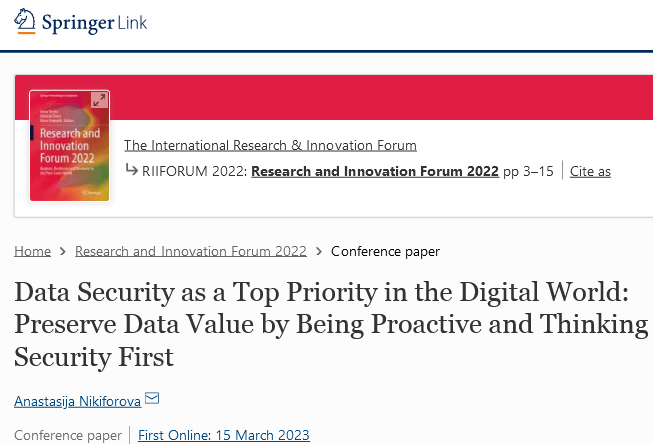
As you probably know from my previous posts, in 2022 I was honored to take part in The International Research & Innovation Forum, where I acted as both, as an author and presenter, panel organizer, session chair / panel moderator, and PC committee. What is more, I even was recognized as the best Best panel moderator award (you can read the post I dedicated to this experience here). Today, I am glad to reflect on the paper – Data Security as a Top Priority in the Digital World: Preserve Data Value by Being Proactive and Thinking Security First – I presented during this conference, which was just published by Springer as part of Part of the Springer Proceedings in Complexity book series (SPCOM).
Today, in the age of information and Industry 4.0, billions of data sources, including but not limited to interconnected devices (sensors, monitoring devices) forming Cyber-Physical Systems (CPS) and the Internet of Things (IoT) ecosystem, continuously generate, collect, process, and exchange data1. With the rapid increase in the number of devices (smart objects or “things”, e.g., smartphones, smartwatches, intelligent vehicles etc.) and information systems in use, the amount of data is increasing. Moreover, due to the digitization and variety of data being continuously produced and processed with a reference to Big Data, their value, is also growing and as a result, the risk of security breaches and data leaks, including but not limited to users’ privacy2. The value of data, however, is dependent on several factors, where data quality and data security that can affect the data quality if the data are accessed and corrupted, are the most vital. Data serve as the basis for decision-making, input for models, forecasts, simulations etc., which can be of high strategical and commercial / business value.
This has become even more relevant in terms of COVID-19 pandemic, when in addition to affecting the health, lives, and lifestyle of billions of citizens globally, making it even more digitized, i.e., the digital environment has replaced the physical, thus it has had a significant impact on business3. This is especially the case because of challenges companies have faced in maintaining business continuity in this so-called “new normal”. However, in addition to those cybersecurity threats that are caused by changes directly related to the pandemic and its consequences, many previously known threats have become even more desirable targets for intruders, hackers. Every year millions of personal records become available online4, 5, 6.
Lallie et al. have compiled statistics on the current state of cybersecurity horizon during the pandemic, which clearly indicate a significant increase of such. As an example, Shi reported a 600% increase in phishing attacks in March 2020, just a few months after the start of the pandemic, when some countries were not even affected.
Miles, however, reported that in 2021, there was a record-breaking number of data compromises, where “the number of data compromises was up more than 68% when compared to 2020”, when LinkedIn was the most exploited brand in phishing attacks, followed by DHL, Google, Microsoft, FedEx, WhatsApp, Amazon, Maersk, AliExpress and Apple.
Recent research7,8,9,10,11 demonstrated that weak data and database protection in particular is one of the key security threats. This poses a serious security risk, especially in the light of the popularity of search engines for Internet connected devices, also known as Internet of Things Search Engines (IoTSE), Internet of Everything (IoE) or Open Source Intelligence (OSINT) Search Engines such as Shodan, Censys, ZoomEye, BinaryEdge, Hunter, Greynoise, Shodan, Censys, IoTCrawler. While these tools may represent a security risk, they provide many positive and security-enhancing opportunities. They provide an overview on network security, i.e., devices connected to the Internet within the company, are useful for market research and adapting business strategies, allow to track the growing number of smart devices representing the IoT world, tracking ransomware – the number and nature of devices affected by it, and therefore allow to determine the appropriate actions to protect yourself in the light of current trends. However, almost every of these white hat-oriented objectives can be exploited by black-hatters. The popularity of IoTSE decreased a level of complexity of searching for connected devices on the internet and easy access even for novices due to the widespread popularity of step-by-step guides on how to use IoT search engine to find and gain access if insufficiently protected to webcams, routers, databases and in particular non-relational (NoSQL) databases, and other more «exotic» artifacts such as power plants, wind turbines or refrigerators. They provide service- and country- wised exposure dashboards, TOP vulnerabilities according to CVE, statistics about the authentication status, Heartbleed, BlueKeep – a vulnerability revealed in Microsoft’s Remote Desktop Protocol that has become even more widely used during pandemics, port usage and the number of already compromised databases. Some of these data play a significant role for experienced and skilled attackers, making these activities even less resource-consuming by providing an overview of the ports to be used to increase the likelihood of faster access to the artifact etc.
According to Risk Based Security Monthly Newsletter, 73 million records were exposed in March 2022, and 358 vulnerabilities were identified as having a public exploit that had not yet been provided with CVE IDs. And while 2021 Year End Report Vulnerability by Risk based security & Flashpoint suggests that vulnerability landscape is returning to normal, there is another trigger closely related to cybersecurity that is now affecting the world – geopolitical upheaval.
In the past, vulnerability databases such as CVE Details were considered useful resources for monitoring the security level of a product being used. Indeed, CVE registry refers to several vulnerabilities they divide into 13 types: (1) bypass something, e.g., restriction, (2) cross-site scripting known as XSS, (3) denial of service (DoS), (4) directory traversal, (5) code execution (arbitrary code on vulnerable system), (6) gain privileges, (7) HTTP response splitting, (8) memory corruption, (9) gain / obtain information, (10) overflow, (11) cross site request forgery (CSRF), (12) file inclusion, (13) SQL injection. However, they are static and refer to very common vulnerabilities in the product being registered when a vulnerability is detected. Advances in ICT, including the power of the IoTSE, require the use of more advanced techniques for this purpose.
While security breaches and different security protection mechanisms have been widely covered in the literature, the concept of a “primitive” artifact such as data management system seems to have been more neglected by researchers and practitioners. But are data management systems always protected by default? Previous research and regular updates on data leakages suggest that the number and nature of these vulnerabilities are high. It also refers to little or no DBMS protection, especially in case of NoSQL, which are thus vulnerable to attacks. The aim of this paper is to examine whether “traditional” vulnerability registries provide a sufficiently comprehensive view of DBMS security, or they should be intensively and dynamically inspected by DBMS owners by referring to Internet of Things Search Engines moving towards a sustainable and resilient digitized environment.
The aim of this paper is to examine both current data security research and to analyse whether “traditional” vulnerability registries provide a sufficient insight on DBMS security, or they should be rather inspected by using IoTSE-based and respective passive testing, or dynamically inspected by DBMS holders conducting an active testing. The paper brings attention to this problem and makes the reader think about data security before looking for and introducing more advanced security and protection mechanisms, which, in the absence of the above, may bring no value. As regards the IoTSE tool, this study refers to Shodan- and Binary Edge- based vulnerable open data sources detection tool – ShoBeVODSDT – proposed by Daskevics and Nikiforova (2021).
This study provided a brief insight of the current state of data security provided by CVE Details – the most widely known vulnerability registry, considering 13 databases. Although the idea of CVE Details is appealing, i.e., it supports stakeholder engagement, where each person or organization can submit a report about a detected vulnerability in the product, it is obviously not sufficiently comprehensive. It can be used to monitor the current state of vulnerabilities, but this static approach, which sometimes provides incomplete or inconsistent information even about revealed vulnerabilities, must be complemented by other more dynamic solutions. This includes not only the use of IoTSE-based tools, which, while providing valuable insight into unprotected databases seen or even accessible from outside the organization, are also insufficient.
The paper shows an obvious reality, which, however, is not always visible to the company. In other words, while this may seem surprisingly in light of current advances, the first step that still needs to be taken thinking about date security is to make sure that the database uses the basic security features: authentication, access control, authorization, auditing, data encryption and network security12,13,14. Ignorance or non-awareness can have serious consequences leading to data leakages if these vulnerabilities are exploited. Data security and appropriate database configuration is not only about NoSQL, which is typically considered to be much less secured, but also about RDBMS. This study has shown that RDBMS are also relatively inferior to various types of vulnerabilities. Moreover, there is no “secure by design” database, which is not surprising since absolute security is known to be impossible. However, this does not mean that actions should not be taken to improve it. More precisely, it should be a continuous process consisting of a set of interrelated steps, sometimes referred to as “reveal-prioritize-remediate”. It should be noted that 85% of breaches in 2021 were due to a human factor, with social engineering recognized as the most popular pattern 15. The reason for this is that even in the case of highly developed and mature data and system protection mechanism (e.g., IDS), the human factor remains very difficult to control. Therefore, education and training of system users regarding digital literacy, as well as the definition, implementation and maintaining security policies and risk management strategy, must complement technical advances.
Nikiforova, A., Daskevics, A., & Azeroual, O. (2023). NoSQL Security: Can My Data-driven Decision-making Be Influenced from Outside?. In Big Data and Decision-Making: Applications and Uses in the Public and Private Sector (pp. 59-73). Emerald Publishing Limited.
Daskevics, A., & Nikiforova, A. (2021, November). ShoBeVODSDT: Shodan and Binary Edge based vulnerable open data sources detection tool or what Internet of Things Search Engines know about you. In 2021 Second International Conference on Intelligent Data Science Technologies and Applications (IDSTA) (pp. 38-45). IEEE.
Daskevics, A., & Nikiforova, A. (2021, December). IoTSE-based open database vulnerability inspection in three Baltic countries: ShoBEVODSDT sees you. In 2021 8th International Conference on Internet of Things: Systems, Management and Security (IOTSMS) (pp. 1-8). IEEE.










 Anastasija Nikiforova, PhD