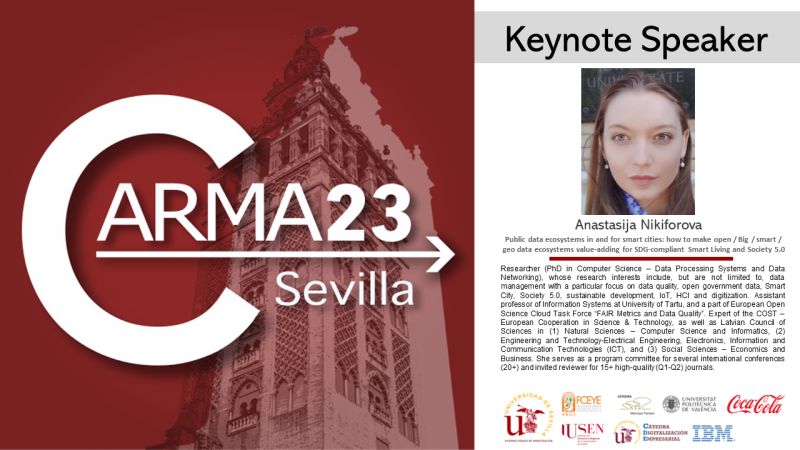
June 28 I had the honor to participate in the opening of CARMA2023 – 5th International Conference on Advanced Research Methods and Analytics “Internet and Big Data in Economics and Social Sciences” delivering my keynote “Public data ecosystems in and for smart cities: how to make open / Big / smart / geo data ecosystems value-adding for SDG-compliant Smart Living and Society 5.0?” in the spectacular city of Sevilla, Spain 🇪🇸 🇪🇸 🇪🇸. What a honor to open the conference, immediately after the inaugural speech by organizers and sponsors, including representatives of Joint Research Center, European Commission (JRC), who even mentioned the topics I covered in my keynote (not limited to them, of course) as those that make this conference an event to attend and to learn from!!!
In this talk, as the title suggests, I:
- elaborated on the concepts of public /open data (incl. OGD), smart city and SDG and how are they related?
- introduced the concept of Society 5.0 and how is it related to open data?
- and finally, and more importantly, public/ open data ecosystem – what it is? what does it consist of?
I then dived into (1) data-related aspects of the public data ecosystem, i.e. what are the data-related prerequisites for a sustainable and resilient data ecosystem? (2) data portal / platforms as entry points and how to make it sufficiently attractive for the target audience? (3) stakeholder engagement – how to involve the target audience? what are the benefits of their involvement? and some more things.
Public data ecosystem part was built around our “Transparency of open data ecosystems in smart cities: Definition and assessment of the maturity of transparency in 22 smart cities“, with some references to other studies such us Transparency-by-design: What is the role of open data portals?, “Timeliness of Open Data in Open Government Data Portals Through Pandemic-related Data: A long data way from the publisher to the user“, “Open government data portal usability: A user-centred usability analysis of 41 open government data portals“, which were previously noticed by the Living Library that recommends studies they see as the “signal in the noise” and the Open Data Institute.
For the data, apart of almost “classical things”, I referred to the topic of “high-value datasets” and dived into a taxonomy we presented in “Towards High-Value Datasets determination for data-driven development: a systematic literature review” (also recommended by the Living Library as the “sound in the noise”), enriched by the results of my earlier study “Towards enrichment of the open government data: a stakeholder-centered determination of High-Value Data sets for Latvia” as well as results of two international workshops we organized.
The part on the public / open data, smart city, SDG and Society 5.0 and how they are interrelated was, in turn, based on our Chapter “The Role of Open Data in Transforming the Society to Society 5.0: A Resource or a Tool for SDG-Compliant Smart Living?”, which was called by FIT Academy “a groundbreaking research”.
And for the engagement, it mostly was about the workshops, datathons, hackathons, data competitions, as we as a co-creation and how the co-creation ecosystem occurs, what are the prerequisites for this etc., incl. referencing to “Open data hackathon as a tool for increased engagement of Generation Z: to hack or not to hack?” and “The Role of Open Government Data and Co-creation in Crisis Management: Initial Conceptual Propositions from the COVID-19 Pandemic“
CARMA is a forum for researchers and practitioners to exchange ideas and advances on how emerging research methods and sources are applied to different fields of social sciences as well as to discuss current and future challenges with main focus on the topics such as Internet and Big Data sources in economics and social sciences including Social media and public opinion mining, Web scraping, Google Trends and Search Engine data, Geospatial and mobile phone data, Open data and public data, Big Data methods in economics and social sciences such as Sentiment analysis, Internet econometrics, AI and Machine learning applications, Statistical learning, Information quality and assessment, Crowdsourcing, Natural Language processing, Explainability and interpretability, the applications of the above including but not limited to Politics and social media, Sustainability and development, Finance applications, Official statistics, Forecasting and nowcasting, Bibliometrics and sciencetometrics, Social and consumer behaviour, mobility patterns, eWOM and social media marketing, Labor market, Business analytics with social media, Advances in travel, tourism and leisure, Digital management, Marketing Intelligence analytics, Data governance, and Digital transition and global society, which, in turn, expects contributions in relation to Privacy and legal aspects, Electronic Government, Data Economy, Smart Cities, Industry adoption.
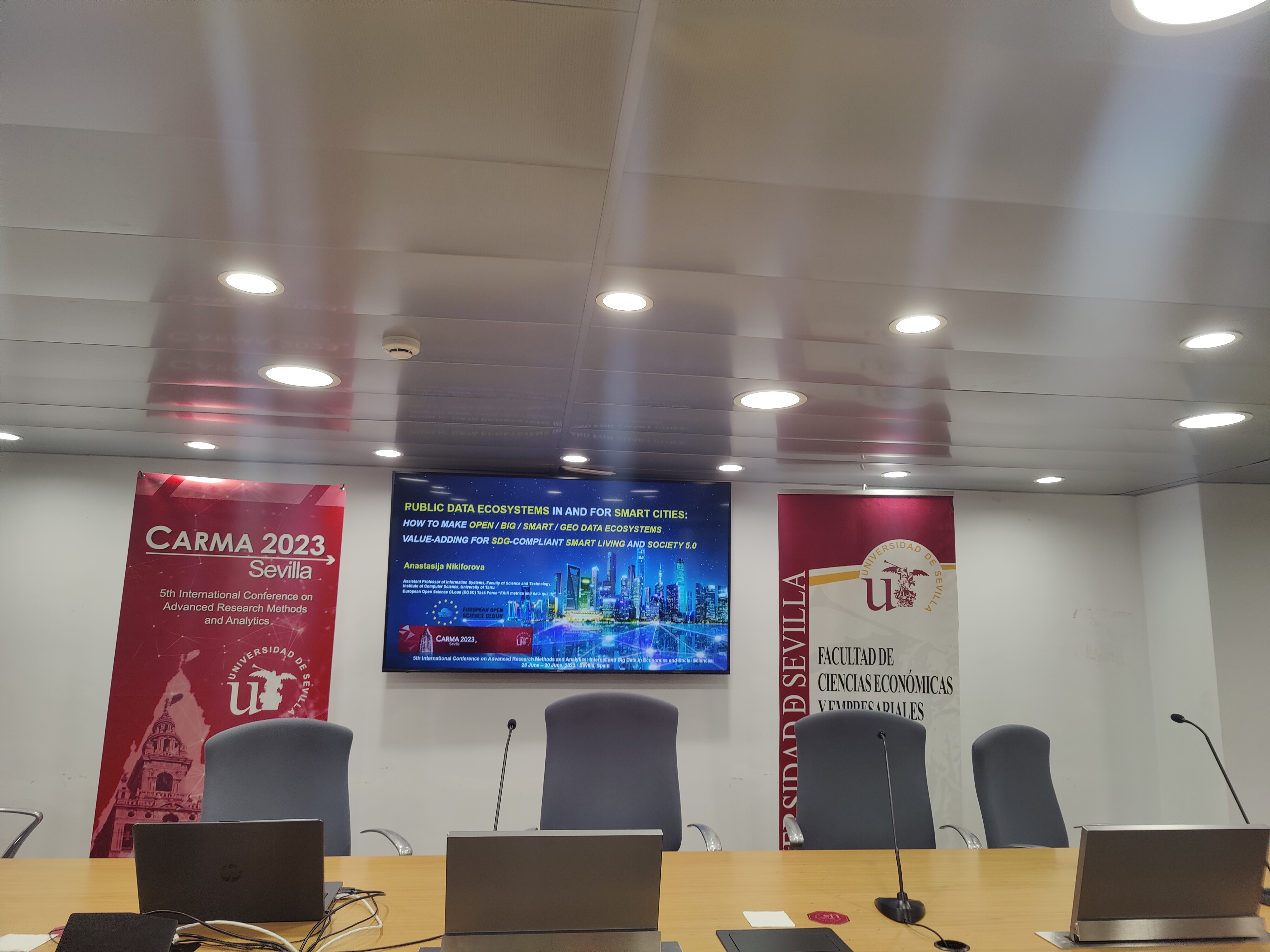
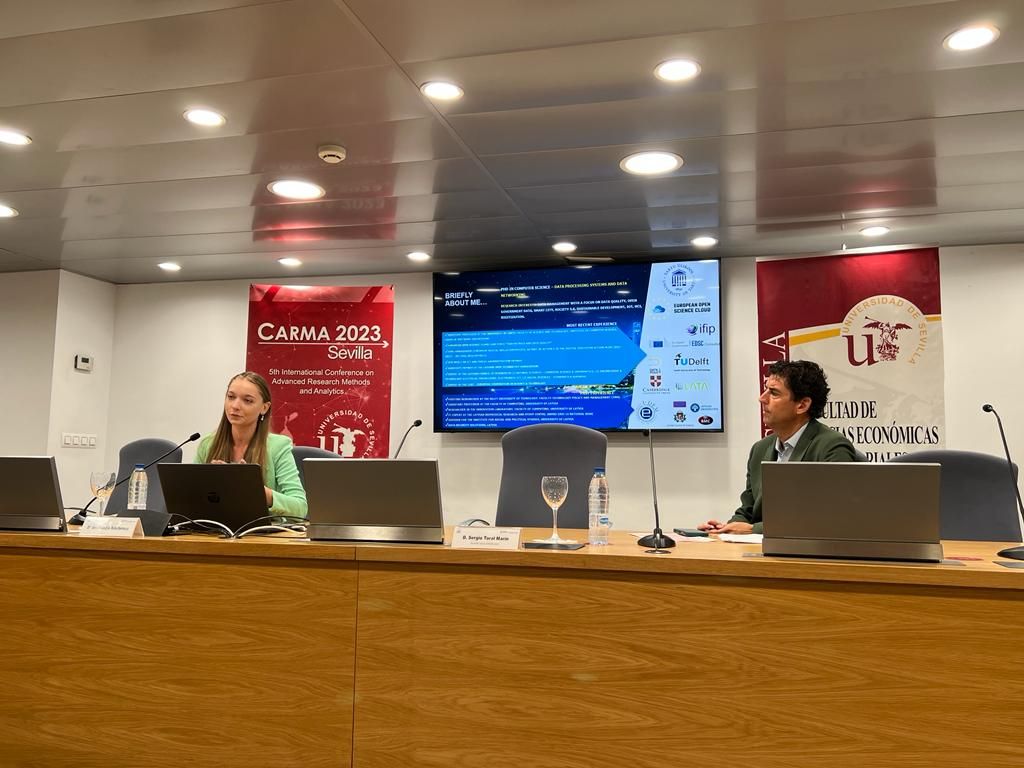
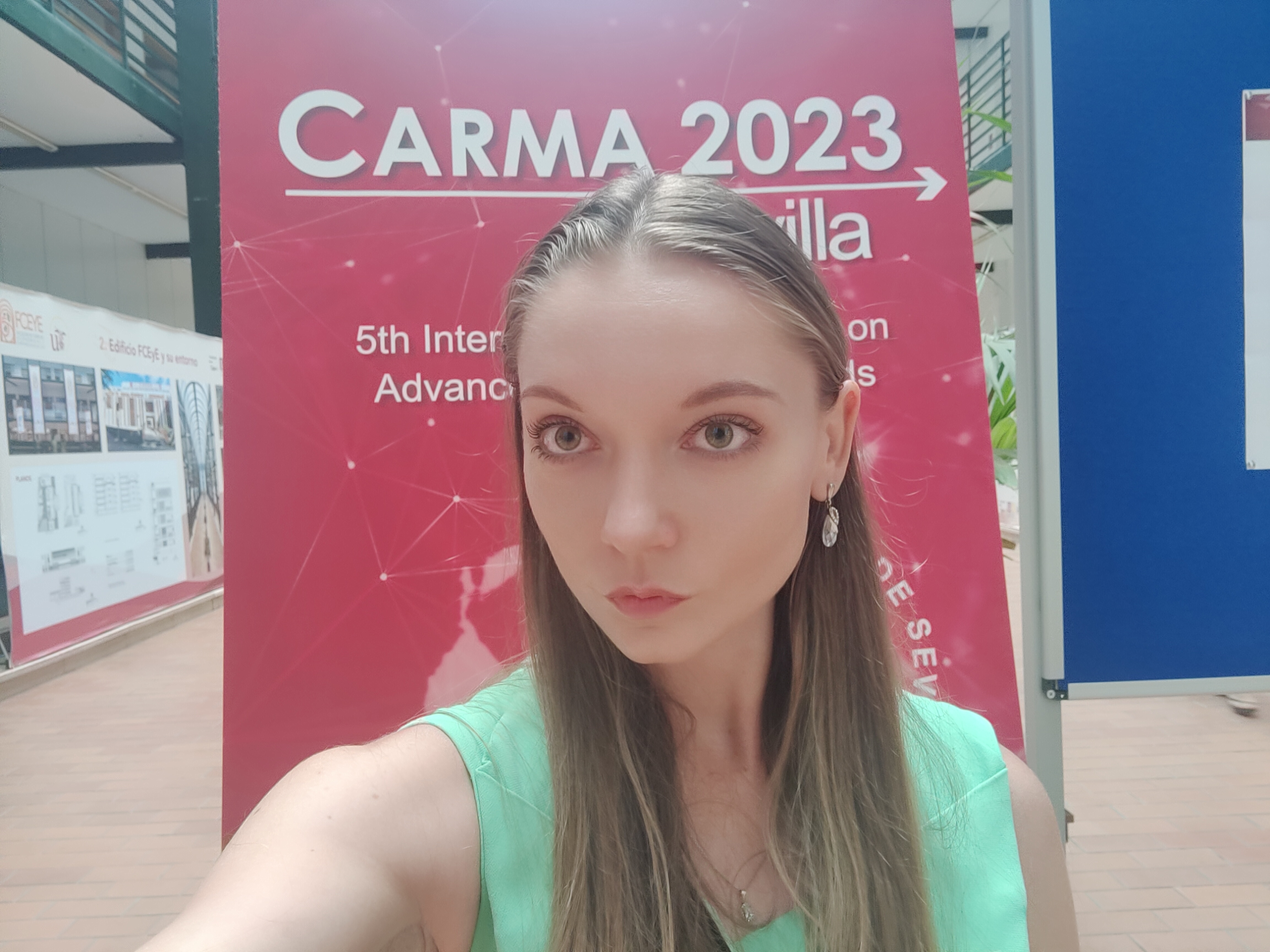
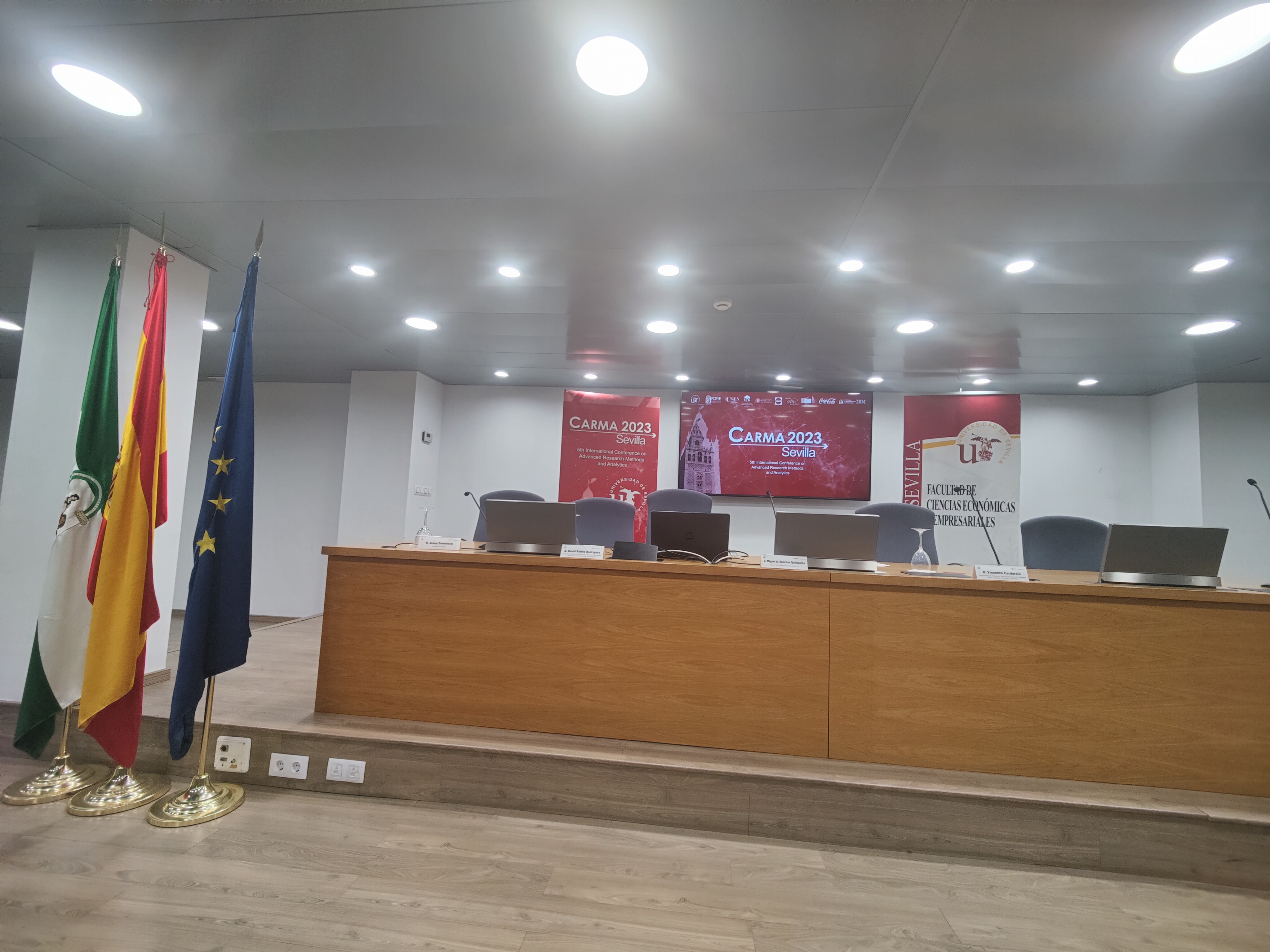

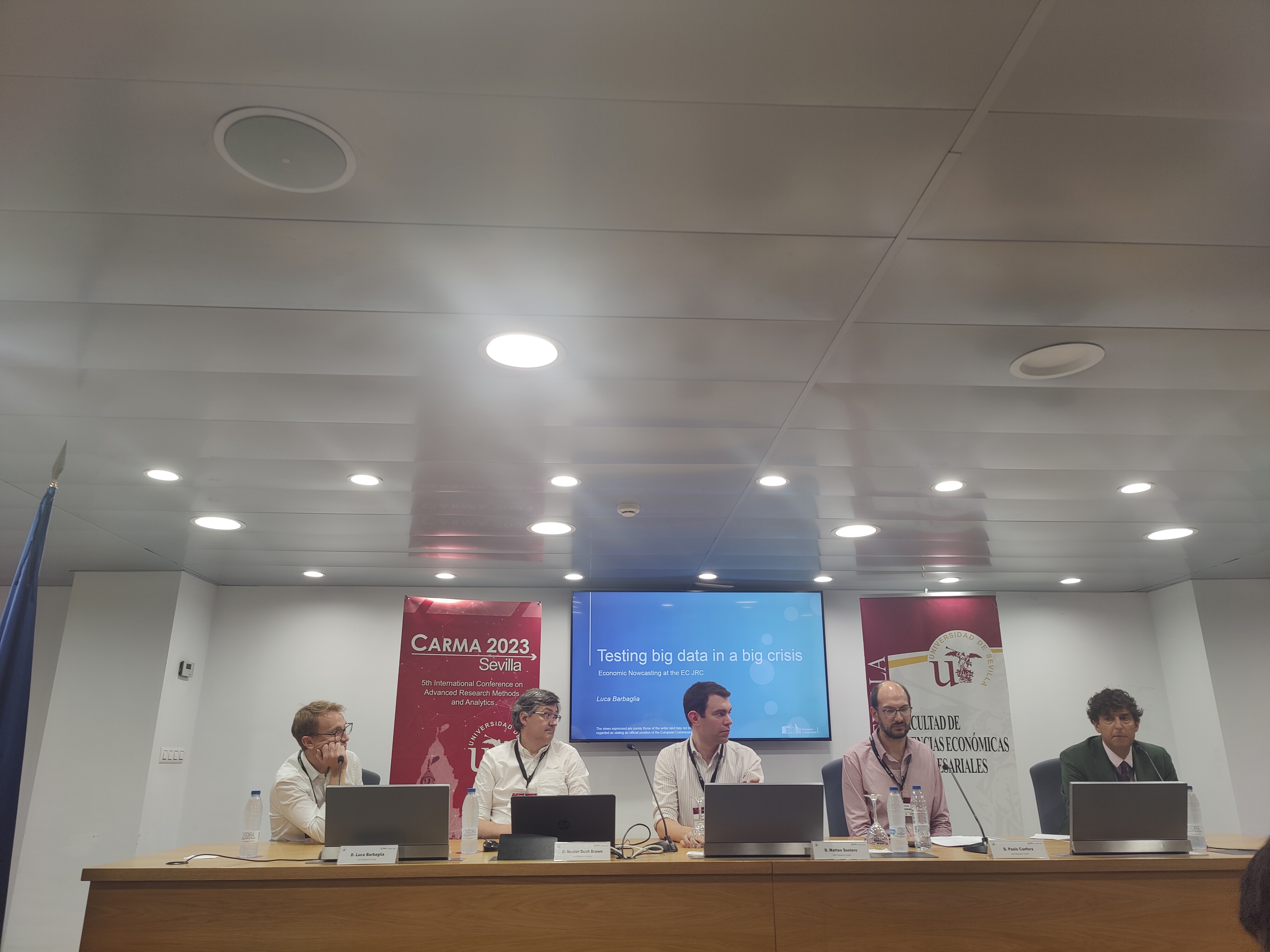
In addition to the regular sessions, poster session and two keynotes, a Special JRC session (EC) took place, during which Luca Barbaglia, Nestor Duch Brown, Matteo Sostero and Paolo Canfora presented projects they work on.
Great thanks goes to organizers and sponsors of CARMA2023 – Universidad de Sevilla, Cátedra Metropol Parasol, Cátedra Digitalización Empresarial, IBM, Universitat Politècnica de València, Joint Research Center – European Commission and Coca-Cola, who made this event a true success. Enjoyed this experience very much! Excellent venue! Great audience! ¡Muchas gracias!
References:
- Nikiforova, A., Flores, M. A. A., & Lytras, M. D. (2023). The role of open data in transforming the society to Society 5.0: a resource or a tool for SDG-compliant Smart Living? In Smart Cities and Digital Transformation: Empowering Communities, Limitless Innovation, Sustainable Development and the Next Generation. Emerald Publishing Limited.
- Lnenicka, M., Nikiforova, A., Luterek, M., Azeroual, O., Ukpabi, D., Valtenbergs, V., & Machova, R. (2022). Transparency of open data ecosystems in smart cities: Definition and assessment of the maturity of transparency in 22 smart cities. Sustainable Cities and Society, 82, 103906, https://doi.org/10.1016/j.scs.2022.103906
- Nikiforova, A. and McBride, K. 2021. Open government data portal usability: A user-centred usability analysis of 41 open government data portals. Telematics and Informatics 58,.
- Nikiforova, A. 2020. Timeliness of Open Data in Open Government Data Portals Through Pandemic-related Data: A long data way from the publisher to the user. 2020 Fourth International Conference on Multimedia Computing, Networking and Applications (MCNA), 131–138.
- Lnenicka, M. and Nikiforova, A. 2021. Transparency-by-design: What is the role of open data portals? Telematics and Informatics 61.
- Nikiforova, A., Rizun, N., Ciesielska, M., Alexopoulos, C., & Miletič, A. (2023). Towards High-Value Datasets determination for data-driven development: a systematic literature review.
- McBride, K., Nikiforova, A., Lnenicka, M. ‘The Role of Open Government Data and Co-creation in Crisis Management: Initial Conceptual Propositions from the COVID-19 Pandemic’. 1 Jan. 2023 : 219 – 238.
- Nikiforova, A. (2022). Open data hackathon as a tool for increased engagement of Generation Z: to hack or not to hack? In International Conference on Electronic Governance with Emerging Technologies (pp. 161-175). Cham: Springer Nature Switzerland.
- Nikiforova, A. (2022). Gen Z open data hackathon–civic innovation with digital natives: to hack or not to hack. In Proceedings of ongoing research, practitioners, workshops, posters, and projects of the international conference EGOV-CeDEM-ePart 202. Linkoping, Sweden (pp. 251-253).
- Nikiforova, A. (2021, October). Towards enrichment of the open government data: a stakeholder-centered determination of High-Value Data sets for Latvia. In Proceedings of the 14th International Conference on Theory and Practice of Electronic Governance (pp. 367-372).
 Anastasija Nikiforova, PhD
One thought on “Keynote at the 5th International Conference on Advanced Research Methods and Analytics (CARMA 2023)”